Positive Cut-Word Models for the Kanade-Russell I1 Bijection Problem
A staircase inside a partition problem
Positive colored cut-word models for auxiliary divided differences, with the complete KR1 bijection still open.
Research status The all-index positive auxiliary models have written proofs. Selected lemmas were checked in Lean; finite tests are supplementary. The full product-to-gap bijection and recurrence maps remain open. This preprint has not been independently peer reviewed.
Release record and SHA-256 checksums · Research source ↗
Release record and SHA-256 checksums · Research source ↗
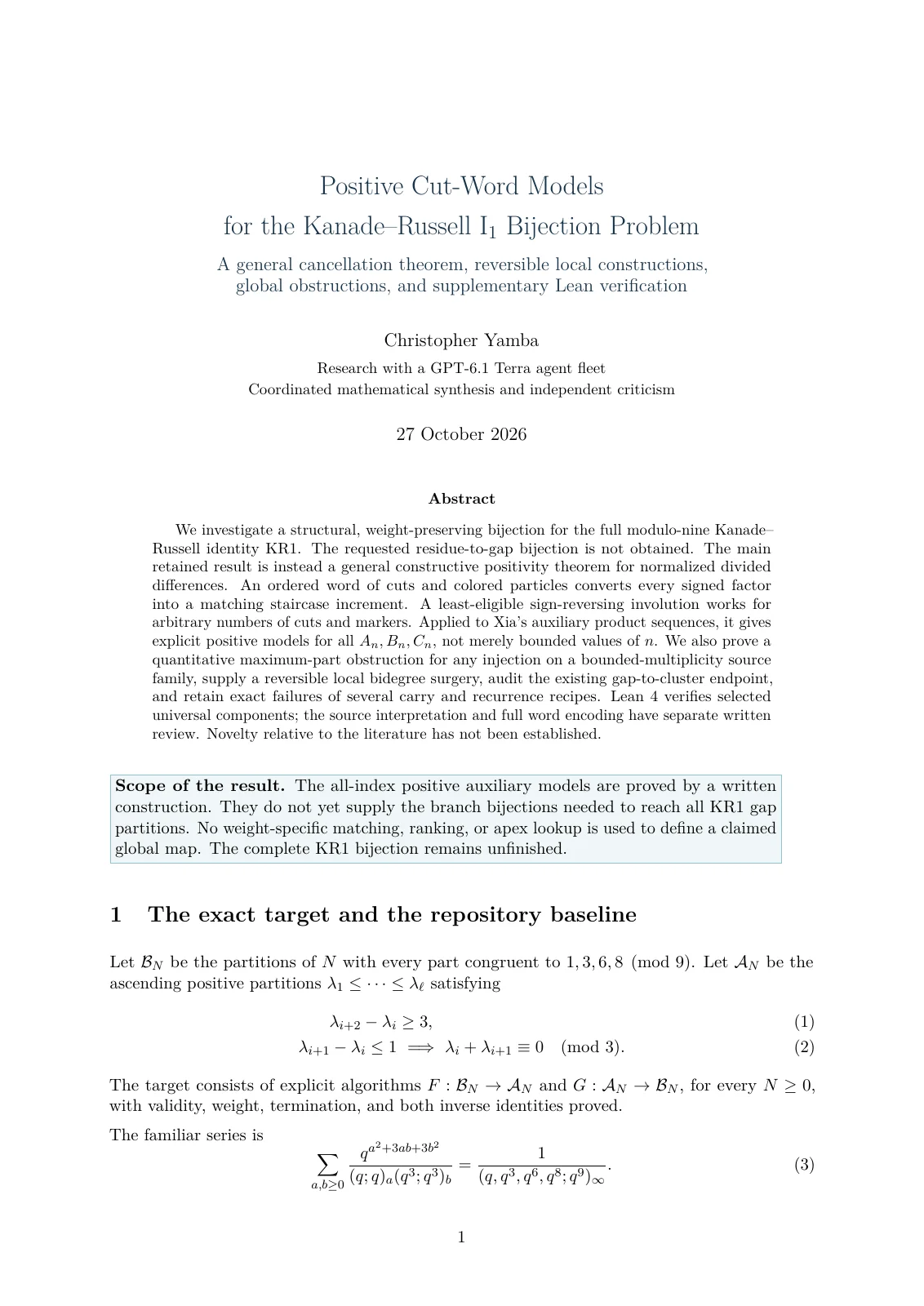
Page 1 of 12 · Original supplied PDF · No editorial changes
Extracted text for this page
Text extraction may omit or reorder mathematical symbols. The page image and original download preserve the visible notation.
                               Positive Cut-Word Models
                for the Kanade–Russell I1 Bijection Problem
               A general cancellation theorem, reversible local constructions,
                 global obstructions, and supplementary Lean verification

                                             Christopher Yamba
                             Research with a GPT-6.1 Terra agent fleet
                    Coordinated mathematical synthesis and independent criticism

                                              27 October 2026


                                                  Abstract

          We investigate a structural, weight-preserving bijection for the full modulo-nine Kanade–
      Russell identity KR1. The requested residue-to-gap bijection is not obtained. The main
      retained result is instead a general constructive positivity theorem for normalized divided
      differences. An ordered word of cuts and colored particles converts every signed factor
      into a matching staircase increment. A least-eligible sign-reversing involution works for
      arbitrary numbers of cuts and markers. Applied to Xia’s auxiliary product sequences, it gives
      explicit positive models for all An , Bn , Cn , not merely bounded values of n. We also prove a
      quantitative maximum-part obstruction for any injection on a bounded-multiplicity source
      family, supply a reversible local bidegree surgery, audit the existing gap-to-cluster endpoint,
      and retain exact failures of several carry and recurrence recipes. Lean 4 verifies selected
      universal components; the source interpretation and full word encoding have separate written
      review. Novelty relative to the literature has not been established.


Scope of the result. The all-index positive auxiliary models are proved by a written
construction. They do not yet supply the branch bijections needed to reach all KR1 gap
partitions. No weight-specific matching, ranking, or apex lookup is used to define a claimed
global map. The complete KR1 bijection remains unfinished.


1    The exact target and the repository baseline

Let BN be the partitions of N with every part congruent to 1, 3, 6, 8 (mod 9). Let AN be the
ascending positive partitions λ1 ≤ · · · ≤ λℓ satisfying

                                 λi+2 − λi ≥ 3,                                                         (1)
                            λi+1 − λi ≤ 1 =⇒ λi + λi+1 ≡ 0               (mod 3).                       (2)

The target consists of explicit algorithms F : BN → AN and G : AN → BN , for every N ≥ 0,
with validity, weight, termination, and both inverse identities proved.
The familiar series is                   2         2
                               X      q a +3ab+3b                 1
                                              3   3
                                                      =                          .                      (3)
                              a,b≥0
                                    (q; q)a (q ; q )b   (q, q , q , q 8 ; q 9 )∞
                                                             3   6


                                                       1