Partition stabilization and semigroup gaps for ternary Parikh matrices
Integer partitions, repeated letters and numerical semigroups
Exact counting formulas for words with repeated letters, connecting ternary Parikh matrices to integer partitions and numerical-semigroup gaps.
The paper gives a bijection with pairs of restricted partitions, exact sizes of specified ternary Parikh-matrix classes, and a numerical-semigroup description of attainable triple deficits. All stated results have written proofs; the three diagrams illustrate the constructions.
Release record and file checksums · Read the original 2006 thesis
First published on the author’s website: . The release record preserves the full timestamp, deployment evidence and checksums of the unchanged downloads.
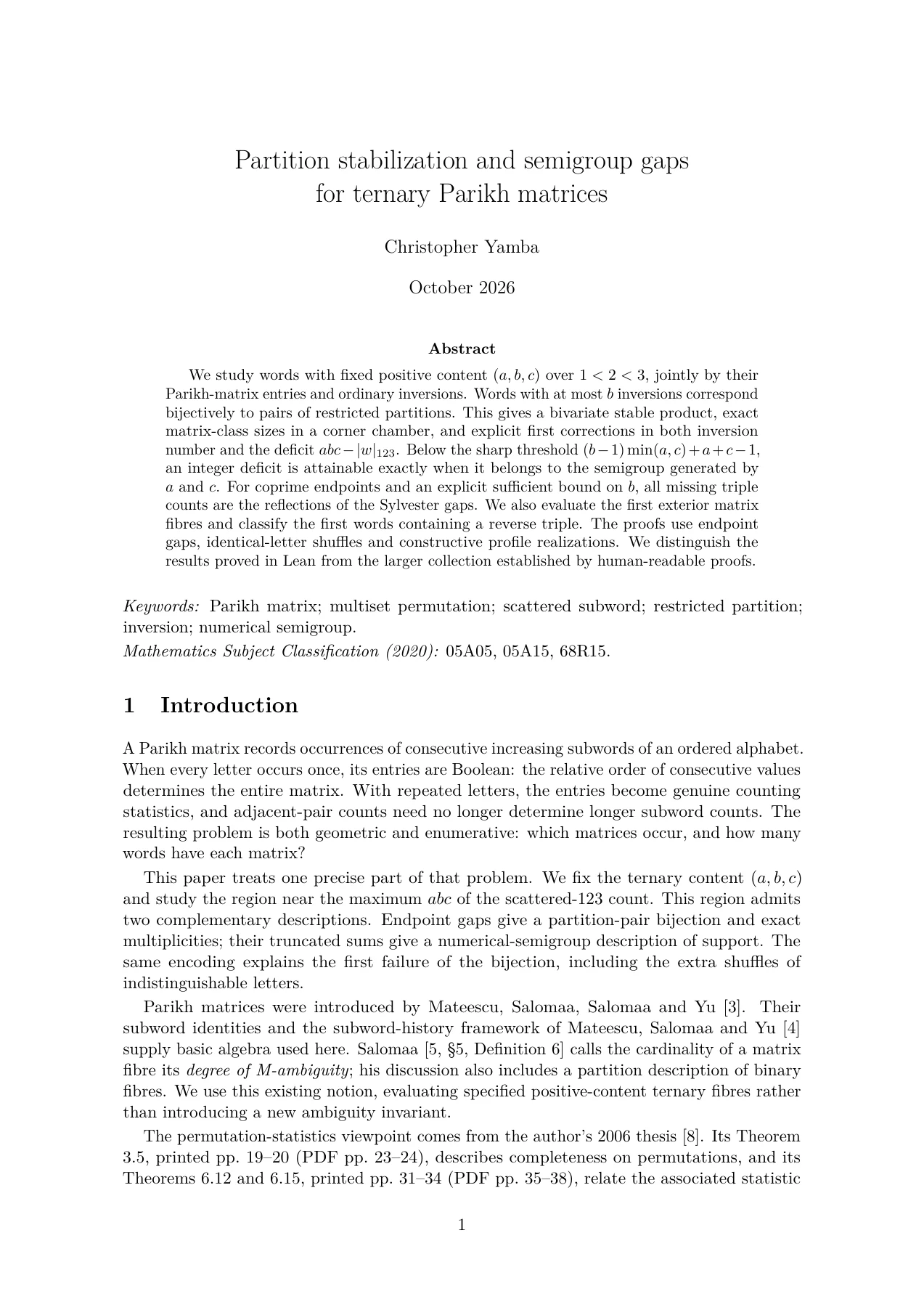
Page 1 of 15 · Original supplied PDF · No editorial changes
Extracted text for this page
Text extraction may omit or reorder mathematical symbols. The page image and original download preserve the visible notation.
Partition stabilization and semigroup gaps
for ternary Parikh matrices
Christopher Yamba
October 2026
Abstract
We study words with fixed positive content(a,b,c ) over 1< 2< 3, jointly by their
Parikh-matrix entries and ordinary inversions. Words with at mostb inversions correspond
bijectively to pairs of restricted partitions. This gives a bivariate stable product, exact
matrix-class sizes in a corner chamber, and explicit first corrections in both inversion
number and the deficitabc−|w|123. Below the sharp threshold(b−1) min(a,c )+a+c−1,
an integer deficit is attainable exactly when it belongs to the semigroup generated by
a and c. For coprime endpoints and an explicit sufficient bound onb, all missing triple
counts are the reflections of the Sylvester gaps. We also evaluate the first exterior matrix
fibres and classify the first words containing a reverse triple. The proofs use endpoint
gaps, identical-letter shuffles and constructive profile realizations. We distinguish the
results proved in Lean from the larger collection established by human-readable proofs.
Keywords: Parikh matrix; multiset permutation; scattered subword; restricted partition;
inversion; numerical semigroup.
Mathematics Subject Classification (2020):05A05, 05A15, 68R15.
1 Introduction
A Parikh matrix records occurrences of consecutive increasing subwords of an ordered alphabet.
When every letter occurs once, its entries are Boolean: the relative order of consecutive values
determines the entire matrix. With repeated letters, the entries become genuine counting
statistics, and adjacent-pair counts need no longer determine longer subword counts. The
resulting problem is both geometric and enumerative: which matrices occur, and how many
words have each matrix?
This paper treats one precise part of that problem. We fix the ternary content(a,b,c )
and study the region near the maximumabc of the scattered-123 count. This region admits
two complementary descriptions. Endpoint gaps give a partition-pair bijection and exact
multiplicities; their truncated sums give a numerical-semigroup description of support. The
same encoding explains the first failure of the bijection, including the extra shuffles of
indistinguishable letters.
Parikh matrices were introduced by Mateescu, Salomaa, Salomaa and Yu [3]. Their
subword identities and the subword-history framework of Mateescu, Salomaa and Yu [4]
supply basic algebra used here. Salomaa [5, §5, Definition 6] calls the cardinality of a matrix
fibre itsdegree of M-ambiguity; his discussion also includes a partition description of binary
fibres. We use this existing notion, evaluating specified positive-content ternary fibres rather
than introducing a new ambiguity invariant.
The permutation-statistics viewpoint comes from the author’s 2006 thesis [8]. Its Theorem
3.5, printed pp. 19–20 (PDF pp. 23–24), describes completeness on permutations, and its
Theorems 6.12 and 6.15, printed pp. 31–34 (PDF pp. 35–38), relate the associated statistic
1