Every rhythm has a shape.
Cut time into events. Turn a rhythm into a ribbon, a Young diagram, and a melody. Discover what each representation remembers.
2 + 1 + 3 = 6
Ribbon
Event order retainedYoung
λ = (3, 2, 1)Ferrers
λ = (3, 2, 1)Conjugate
λ′ = (3, 2, 1)The k-th part of the conjugate counts the events lasting at least k units. A partition represents an inventory of durations, not a unique melody.
Build the rhythm, one gap at a time
Click a gap: 0 continues an event →; 1 begins the next event ↓. All parts stay positive.
01100The musical representation
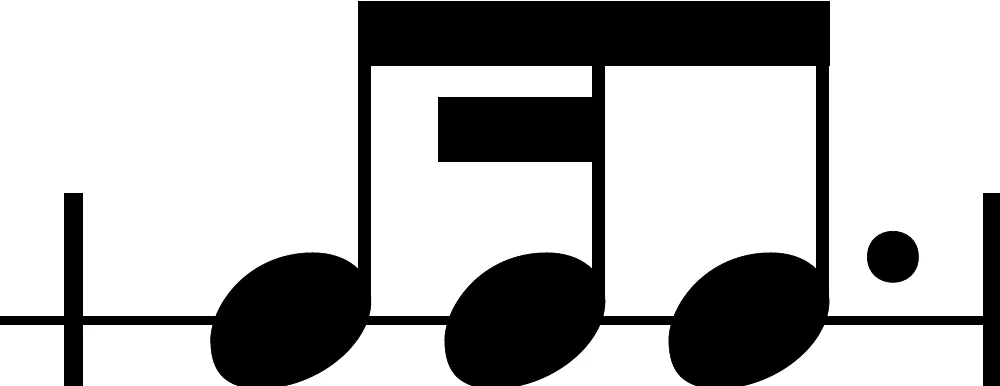
Each rectangle is an event; width is duration and height is pitch. Rests sit below the pitch grid. Adjacent rests are disabled to preserve the manuscript’s canonical model.
What does q count?
Duration · the manuscript’s melody series
M5(q) = (1 − q) / (1 − 7q + q²)1 + 6q + 41q^2 + 281q^3 + 1926q^4 + 13201q^5 + 90481q^6 + …
[q6] M5(q) = 90,481
This coefficient counts every legal melody of duration 6. Your chosen rhythm alone admits 205 pitch/rest assignments; its partition admits 1,230.
Inversions · an exploratory q-analogue
Fλ(q) = Σrhythms r with inventory λ qinv(r)1 + 2q + 2q^2 + q^3
Here q tracks inversions of the duration sequence, not elapsed time. An inversion is a pair i < j with dᵢ > dⱼ. This companion experiment does not add a claim to the manuscript. Fλ(1) = 6 = ℓ! / ∏ mk!.
Find the hidden rhythm.
Reconstruct a duration sequence from its Young diagram and inversion count. The representations above update together as you try each cut.