Combinatorial Mathematical Music Theory
Original manuscript · 2005
An early programme connecting musical sets and mappings, multiset permutations, descent statistics, Parikh matrices, and q-analogues.
Original Word manuscript with a reading copyThe 2005 .doc file is preserved byte for byte. The browser reader and its PDF are a LibreOffice rendering for convenient reading; pagination and font substitution may differ from Microsoft Word. No prose or mathematical content has been edited.
Original file checksums · Download derived reading PDF
Original file checksums · Download derived reading PDF
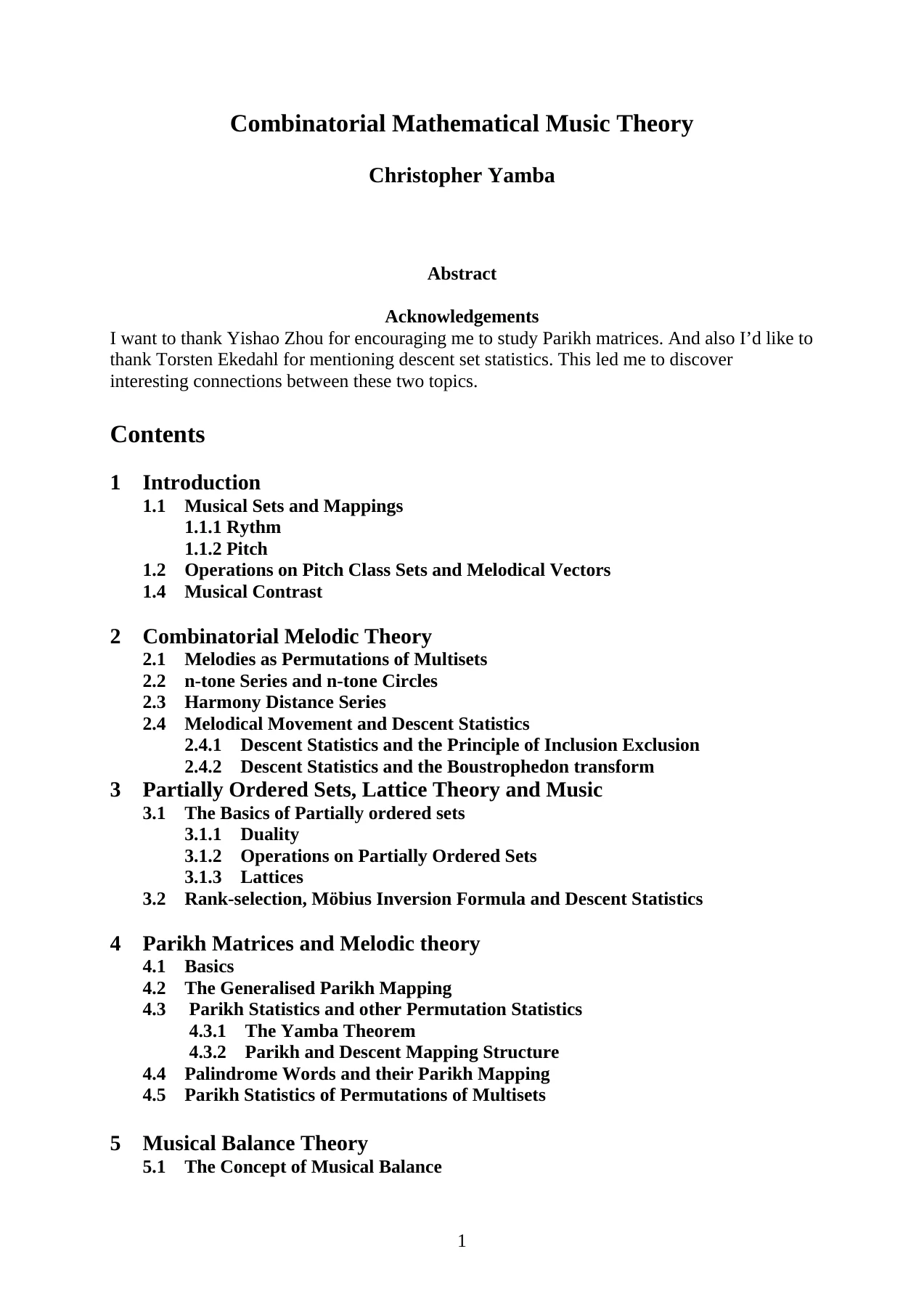
Page 1 of 72 · Reading copy of the original 2005 Word file · No editorial changes
Extracted text for this page
Text extraction may omit or reorder mathematical symbols. The page image and original download preserve the visible notation.
Combinatorial Mathematical Music Theory
Christopher Yamba
Abstract
Acknowledgements
I want to thank Yishao Zhou for encouraging me to study Parikh matrices. And also I’d like to
thank Torsten Ekedahl for mentioning descent set statistics. This led me to discover
interesting connections between these two topics.
Contents

1    Introduction
       1.1    Musical Sets and Mappings
                1.1.1 Rythm
                1.1.2 Pitch
       1.2    Operations on Pitch Class Sets and Melodical Vectors
       1.4    Musical Contrast
2    Combinatorial Melodic Theory
       2.1    Melodies as Permutations of Multisets
       2.2    n-tone Series and n-tone Circles
       2.3    Harmony Distance Series
       2.4    Melodical Movement and Descent Statistics
                2.4.1    Descent Statistics and the Principle of Inclusion Exclusion
                2.4.2    Descent Statistics and the Boustrophedon transform
3    Partially Ordered Sets, Lattice Theory and Music
       3.1    The Basics of Partially ordered sets
                3.1.1    Duality
                3.1.2    Operations on Partially Ordered Sets
                3.1.3    Lattices
       3.2    Rank-selection, Möbius Inversion Formula and Descent Statistics
4    Parikh Matrices and Melodic theory
       4.1    Basics
       4.2    The Generalised Parikh Mapping
       4.3     Parikh Statistics and other Permutation Statistics
                 4.3.1    The Yamba Theorem
                 4.3.2    Parikh and Descent Mapping Structure
       4.4    Palindrome Words and their Parikh Mapping
       4.5    Parikh Statistics of Permutations of Multisets
5    Musical Balance Theory
      5.1    The Concept of Musical Balance
1