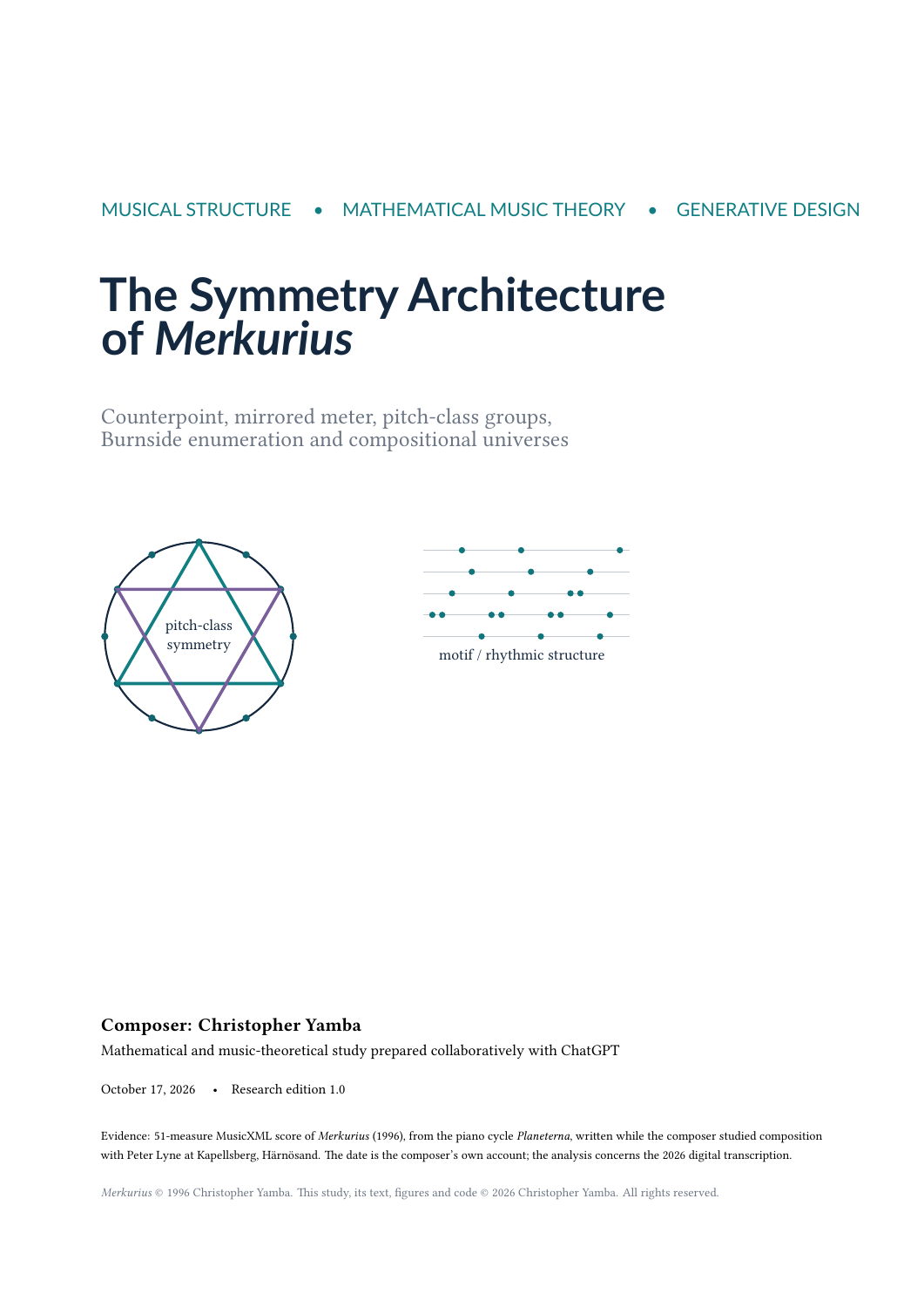
I composed Merkurius for piano in 1996, while I was studying composition with Peter Lyne at Kapellsberg in Härnösand, Sweden. It belongs to a series of pieces I called Planeterna ("The Planets"), together with Charon for piano, named after Pluto's moon, and Ganymedes for piano, piccolo and cello, named after one of Jupiter's moons. I wrote them before I knew Holst's orchestral suite The Planets. Of the three, Merkurius is perhaps the most mathematical.
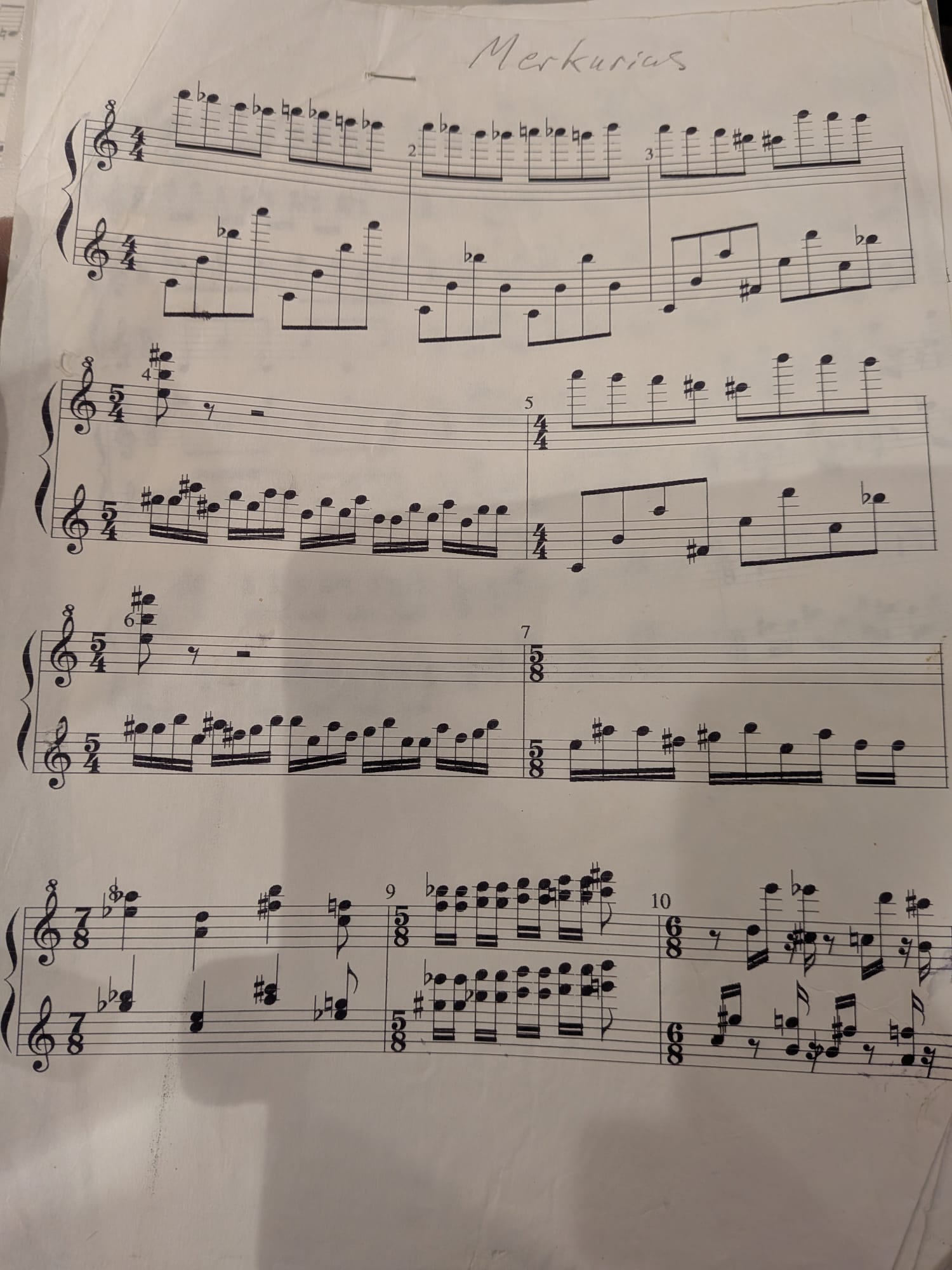
Thirty years later I started going through my old compositions to archive them, and analysing them turned out to be more interesting than filing them away. Read as a mathematical object, the score of Merkurius is built from a small set of exact symmetries:
- The time signatures of bars 5 to 48 form a palindrome: bar m has the same meter as bar 53 − m, across 44 bars.
- A fast 20-note line on five pitch classes returns as its exact retrograde, in bars 6 and 34 and in bars 19 and 47. The inversion that links the two pairs differs in exactly one note, which the original score will have to settle.
- A second line, on four pitch classes, appears exactly as original, inversion and retrograde, in bars 4, 17 and 36.
- Inverting the E Lydian scale chromatically gives E Mixolydian.
- In the first bar one hand falls by semitones while the other rises by major sevenths, so the interval between the hands stays a major sixth.
- Bars 13, 26 and 40 split a whole-tone scale into two complementary augmented triads.
The article develops the group theory behind these observations. It uses Burnside's lemma to count how many genuinely different phrases such a system allows, for example 304 classes of marked five-note phrases, and it explains a 35-note cycle that appears when a five-note motif meets a repeated note every seven notes. The findings are checked by computer against the digital score, and the article keeps what the score literally contains apart from interpretation.
Next, I want to turn these structures into compositional techniques and write new pieces with them, drawing on what I have learnt since 1996 in mathematics, computer science, physics, AI, biology and bioinformatics.
Merkurius © 1996 Christopher Yamba. The article © 2026 Christopher Yamba. All rights reserved.